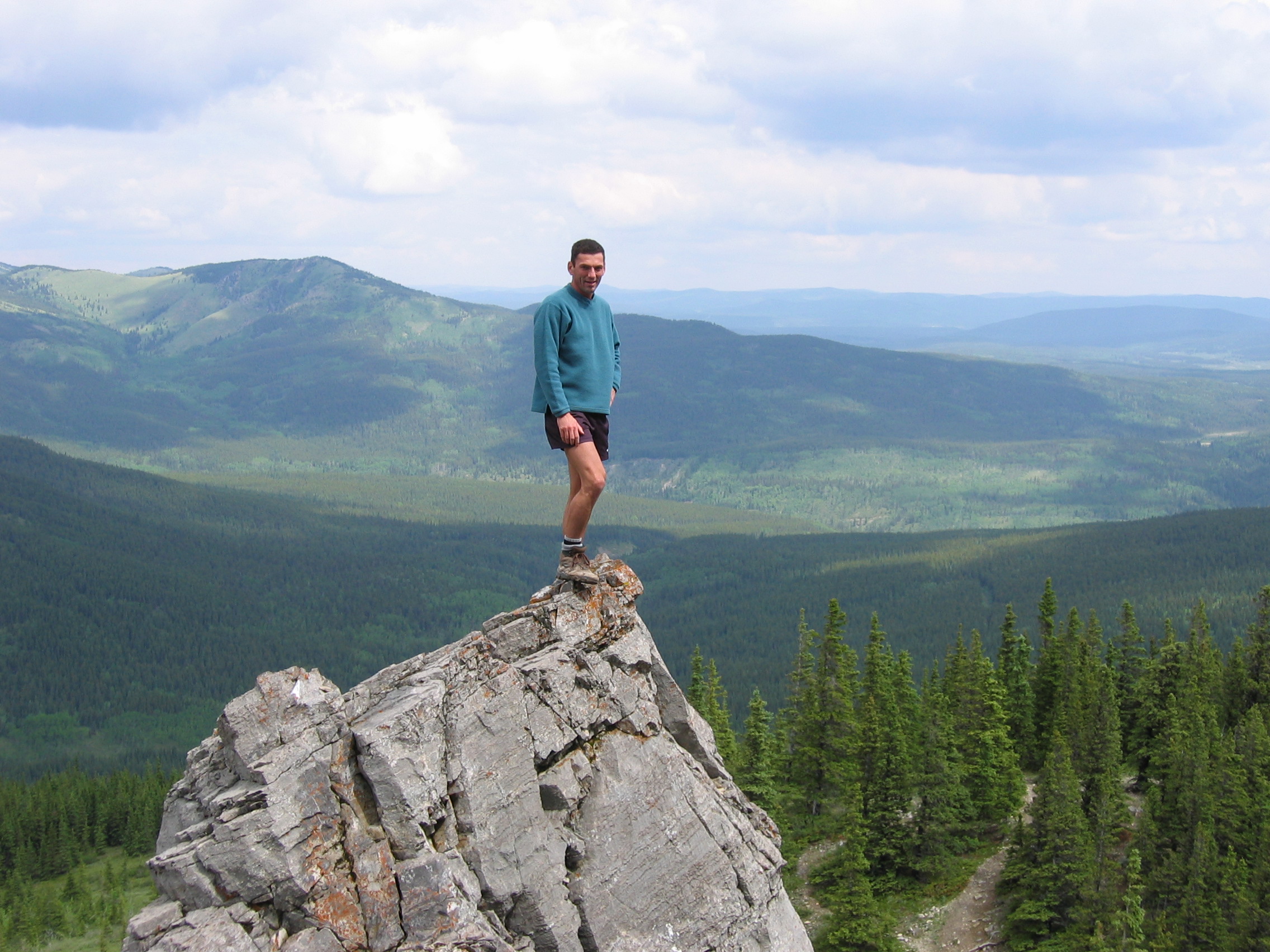
I have had the privilege of summiting many mountains in my lifetime, though that wasn’t something I set out to do as a child when I first fell in love with the forest. I remember only that another boy showed me a picture of his birth home in the Canadian Rockies, with him standing in front of a house with a snow-capped peak in the background, and that I dreamed ever after of visiting the mountains, not to climb them, but to see them with my own eyes, and to frolic in their forests like I did at home in Ontario. I hoped also one day to see a grizzly bear, a mountain goat, and a puma or a mountain lion (I learned later that we call them ‘cougars’ in Canada).
My route to the Canadian Rockies was a circuitous one. I had never been to western Canada until I reached my military years, but it required a posting first to Germany (West Germany at the time), a winning performance in the regional soccer tournament, and finally a trip back to Calgary for the soccer nationals. While in Calgary, just before the tournament started, I rented a car and drove in the early morning with a teammate to Banff, where we absorbed the mountain air and went on a hike up the trail to the top of the gondola on Sulphur Mountain, before returning to Calgary for our dinner curfew.
I was already in my mid-twenties before I first hiked to the summit of a mountain, whose name I have forgotten. I had signed up for a five-day military adventure training program. The purpose of the program was to provide challenging alternatives to specific military training, with the goal of making a more well-rounded soldier. In the German Alps, we learned to climb with ropes and learned some basic mountaineering techniques.
On one of the five days, two members of a German military unit, an officer and a sergeant, led us on a scramble up a mountain, with the officer leading and the sergeant covering the back of the line. The officer was a bit of a dick, starting off at a blistering pace and seemingly trying to prove that no one could keep up. I did keep up, however, (Canadian pride you know), but he nearly broke me, and just when I was ready to trip him up from behind and toss him off the mountain for his arrogance, he decided to take a break. I was happy to see at that point that he was just as winded as I was. Though we had only been climbing for about twenty minutes, it still took another twenty-five minutes for the last of our group to catch up. When the sergeant finally arrived from the end of the line, he scolded the officer publicly for being such an ass, and when we continued after our break, the officer set a more reasonable pace.
I admit that I felt pretty good about myself, about how my body was standing up to the challenge of hiking a steep uphill, how I was able to maintain pace with the fastest climber among us. But then we passed a man who was on his descent, a man who had such bad knees that he was walking with forearm crutches and braces. I was humbled and realized then that mountains were accessible to anyone with determination and that speed didn’t matter to those who loved the mountains, the summits, and the vistas.
When I was posted back to Canada, I went to university for four years in Ontario and then asked my career manager if there was a chance I could be posted to the 1st Brigade in Calgary. My request was granted, and for the next many years, the Canadian Rockies became my recreational backyard. Despite that I had climbed a mountain in Germany, it never occurred to me that I might be able to climb mountains in the Canadian Rockies, thinking that they were much more rugged that the German Alps, which in general they are. I was hoping just to do some hiking in the mountains and on my first visit to Banff, I picked up a trail map and hiked up Cascade Mountain to the Cascade Amphitheatre, which is essentially a cirque with steep walls on the southwest flank of the mountain.
There were other hikers in the Amphitheatre as well enjoying their lunches, but then when I looked up, I could see people climbing just below the summit. I watched two hikers as they descended, and when they broke through the trees, I asked them about how I might get to the summit myself. They pointed out the route and said that if I was interested in climbing other mountains as well, that I should pick up a copy of Alan Kane’s Scrambles in the Canadian Rockies, which they said was the Bible for summiting mountains in the Canadian Rockies.
This was when I learned that, in Canada, scrambling meant reaching summits that might require the use of one’s hands, but not necessarily a rope. That first climb up Cascade Mountain in 1995 was successful in that I reached the summit and managed to get back home without serious injury, but it was a learning experience in being prepared. I made two major mistakes on that climb. First, I didn’t take enough water and, indeed, I actually ran out at the summit. By the time I got back to my car, I was so dehydrated that I collapsed on the parking lot after grabbing a one-litre bottle of water that had been sitting in the sun on my front seat. The water was disgusting, but it kept me going. When I got back into Banff, I drank another two litres of water without batting an eyelash.
My second mistake was that I didn’t judge the terrain correctly. On descent, delirious with thirst, I thought to take a short cut down the mountain, but soon found myself above a high cliff and needed to expend considerable energy to get back up to the main path. My first mistake resulted in the second, but happily, I never made those mistakes again in all my years of scrambling. Indeed, I almost always carried more water than I needed (which of course means more weight) and more often than not came off the mountain with plenty of water to spare.
I never sought the goals of other types of climbers, those who used ropes, those who wanted to be first up a route, or the first Canadian, or the first without bottled oxygen, or the fastest, or anything like that. Those were fantasies I may have had, but when I thought about them realistically, and considered what it would take to be the first or best, I knew that trying to break records was not for me. I liked to remain under the radar most of the time, and I knew from the start that hiking and scrambling were only going to be my recreational activities, not my career. At best, I wanted to see if I could eventually complete all of the scrambles in Alan Kane’s original book, which I finally managed, but now, when I look at the new list in the third edition of Kane’s book, I see that I am still a dozen peaks short, not to mention the dozens of mountains I haven’t summited in Andrew Nugara’s subsequent series, More Scrambles in the Canadian Rockies. And frankly I can live with that.
What I discovered in scrambling up all those peaks in the Canadian Rockies is that some mountains are more fun and interesting than the others (for example, I hate bushwhacking through thick alpine forest to get to an access route), so now when I find myself back there during hiking season, I am repeating mountains I have already climbed. To me, this simply means that there is joy in scrambling for its own sake, not to become famous or for bragging rights.
Despite that I enjoy climbing mountains, I never made it a point to climb very high mountains. To date, I have only climbed two mountains that, without acclimatization, have caused me symptoms of altitude sickness – Pikes Peak in Colorado at 4,302 metres, and Acatenango Volcano in Guatemala at 3,976 metres – which makes me believe that, without proper preparation, I could likely climb to about 3,900 metres before I would feel sick. Despite my rather limited altitude experience, my friends still think of me as a mountain man.
Before scrambling, my first love had always been hiking, and it still is. But somewhere along the way, I found that, while hiking was the enjoyment of the journey and not the destination, summiting mountains gave me the additional satisfaction of completing a goal. For most people, the idea of climbing to the top of a mountain, particularly one without an established trail and that requires hiking well above tree-line, is quite daunting. To climb a mountain is to set a goal, one that is usually easily defined, that is, to reach the summit, or, to reach the summit and return safely home without injury, or, to do all of that in a specific time frame (there is a debate in the climbing world – some say that if one reaches the summit but dies on descent, the mountain hasn’t been properly climbed).
To climb a mountain, even one that can be climbed in a few hours, requires at least some preparation, such as studying a map or a trail guide, arranging supplies, securing transportation, and having an emergency and communication strategy. Generally, one only needs to budget a single day to climb one of the mountains in Kane’s scramble book. I think my longest day on a scramble was seventeen hours, but I had wanted to challenge myself that day by reaching a series of four peaks connected along a chain of mountains.
When a scramble is finished, you have succeeded in a significant goal – climbing a mountain. I actually used this strategy when I was marketing a military adventure training program of my own design. I told people who were anxious about the idea that I would help them climb to the top of a mountain, a success that no one would ever be able to take away from them – for the rest of their lives, they could always say they had climbed a mountain.
And the strategy worked. Eventually, I had members of other medical units across Canada join my annual adventure training in the Canadian Rockies, and then later, after I was posted away from Edmonton, it was made into a national program by the Canadian Medical Services.
Climbing a mountain – such is the dream of many people who have never been to western Canada. If one considers immortality, many of the people I have led to the summits of mountains in the Canadian Rockies have subsequently taken others to those summits, who then have taken further friends and family members. That gives me much satisfaction in my autumn years.
The reason that the goal of climbing a mountain was so appealing to me is that I wasn’t getting the satisfaction of accomplishment in my working life. In my military career, goals were often so long-term that I had already been posted before they were completed. Or, in many cases, the mission was such that we couldn’t actually identify how success was measured, whether we had attained it at the end, or to what extent. Climbing a mountain gave me that feeling of accomplishment – set a goal, plan for the goal, and either succeed or not with the goal, and do it all in one day.
What made it realistic and fun was the fact that I didn’t always succeed in my goal. Occasionally, I didn’t reach the summit. On a few mountains, while hiking alone, I thought the risk in certain spots was too high for the weather conditions or without ropes, so I turned back. One must reasonably know their own limits when serious injury or death could be the result of a mistake in judgement. Still, I did sometimes expose myself to more danger than a reasonable Dave would have, but I became less obsessed over time and thankfully didn’t pay the penalty for my poor judgements.
At the beginning when I was scrambling up mountains, I treated them as fitness exercises, climbing as quickly as possible. This wasn’t only to test my physical stamina, but it was practical as well because I had family and social obligations, and if I wanted to summit mountains as a hobby, I needed to ensure it wasn’t interfering with those other things. While living in Calgary, I would wake up at 0400 on Saturdays and Sundays, drive to the mountains, climb up to a peak, and be home by noon or early afternoon to spend time with my family. Later, in my retirement, I began climbing mountains at a steady, but more leisurely, pace.
I was always up for a challenge when scrambling. Once, when I stopped in Canmore at a coffee shop before continuing on to my mountain of choice, I overheard a young woman bragging to her friend that her boyfriend, who was an ultra-marathoner, ran up Mount Yamnuska in sixty minutes. I was thinking about that while waiting for my coffee and then decided to alter my original plan and head to Yamnuska, which I managed to climb in 65 minutes, without running, giving myself exercise-induced asthma in the process, which didn’t ease up until the next day. But still, it was a challenge and fun as hell!
That was an exhausting year in Calgary, but so rewarding for my physical and mental health. When I was posted to Edmonton, however, the distance to the mountains made this routine impossible. Still, I always managed to scrape together a couple of weeks each year to do some scrambling. Later, after I retired from the military, I would spend long weeks at a time in the mountains, hiking and scrambling.
At the age of 55, feeling that I was becoming a little too comfortable in my middle-aged life (and a little too thick around the middle for my liking), I decided to challenge myself by climbing 55 mountains in 55 days, selecting the peaks out of both Kane’s and Nugara’s scramble books. I managed to complete this goal in well under 55 days and found that it rekindled my adventurous spirit and my outlook in life. Much as I looked at life as a teenager, all of the world was in front of me and all was still possible.
Since I moved to British Columbia’s south Okanagan, I have climbed every peak in the area that had a name, even though I wouldn’t call many of the local peaks ‘mountains’ despite their monikers (one of the peaks can literally be climbed in five minutes from the trailhead). These peaks rarely get above tree-line, but they are enjoyable nevertheless. I have my favourites here, just as I did in the Canadian Rockies, and time and accessibility make them more frequent outings.
I’m not sure at this point what my relationship will continue to be with the Canadian Rockies. The last time I climbed Yamnuska was in 2015, twenty years after I climbed it for the first time. In 1995, the trailhead parking lot was small and there were only five cars parked there. In 2015, I counted 155 cars parked in the new super-sized trailhead lot!
On Yamnuska, on the south slope, there is a tremendous amount of scree, which is a lot of fun to bound down toward the main trail, as fun as downhill skiing. But in 2015, I noticed that the scree line was thin at the top and the scree had now been pushed at least two hundred metres further down the trail, just from human use. Consider the Sierra Club’s famous environmental dictum – “Take only photographs – leave only footprints.” Well, the footprints, if there are enough of them, matter too.
I haven’t been back to Yamnuska since and likely won’t, ashamed really for my contribution to changing that pristine landscape. But still, there are more remote mountains that call my name, that are much less frequently visited because of their location and difficulty level, so we’ll see. There are also numerous hiking trails in the Canadian Rockies that are remote from the tourist day hikers and that have never experienced my footfall, and some of those intrigue me as well (journey, not destination), so we’ll see what the future holds.
Hi Dave,
Congratulation to your achievements. I have read your post and i am totally amazed. honestly. i never experience hike to mountains or visiting forest in Canada, but i am living in Canada for a long time. i have question, how you manage avoiding or not even encounter a bear or any wildlife on our mountains here? i love nature but if i am thinking , what if i encounter one? what i am going to do? this is an honest and innocent question actually. sorry about this. Thanks if you answer. 😊
Hi Ellai. I think that the fear of a bear encounter is worse than the reality. Hiking in bear country means that eventually you will come across a bear and I feel that I am fortunate to have seen many in my hiking travels. I am no expert on bears, but in my experience, when I have come across a bear, we have both done the right thing and tried to avoid one another. Some people carry bear bells and bear spray, but I haven’t done so. I find the bells ruin a good quiet hike and I am more likely to hurt myself than the bear with spray. If I come across some fresh scat or if I’m alerted to a bear by another hiker, I will sing to alert the bear. My singing is so bad that it will scare away anything. If you are actually approached by a bear aggressively, don’t make eye contact. Make yourself look big (maybe by lifting your pack over your head) and back away slowly. Don’t run; just keep your composure. Hope this helps a bit.
Still remember scrambling Grotto Mountain with you and Bill. I also remember how much it kicked my ass!!
Good times!