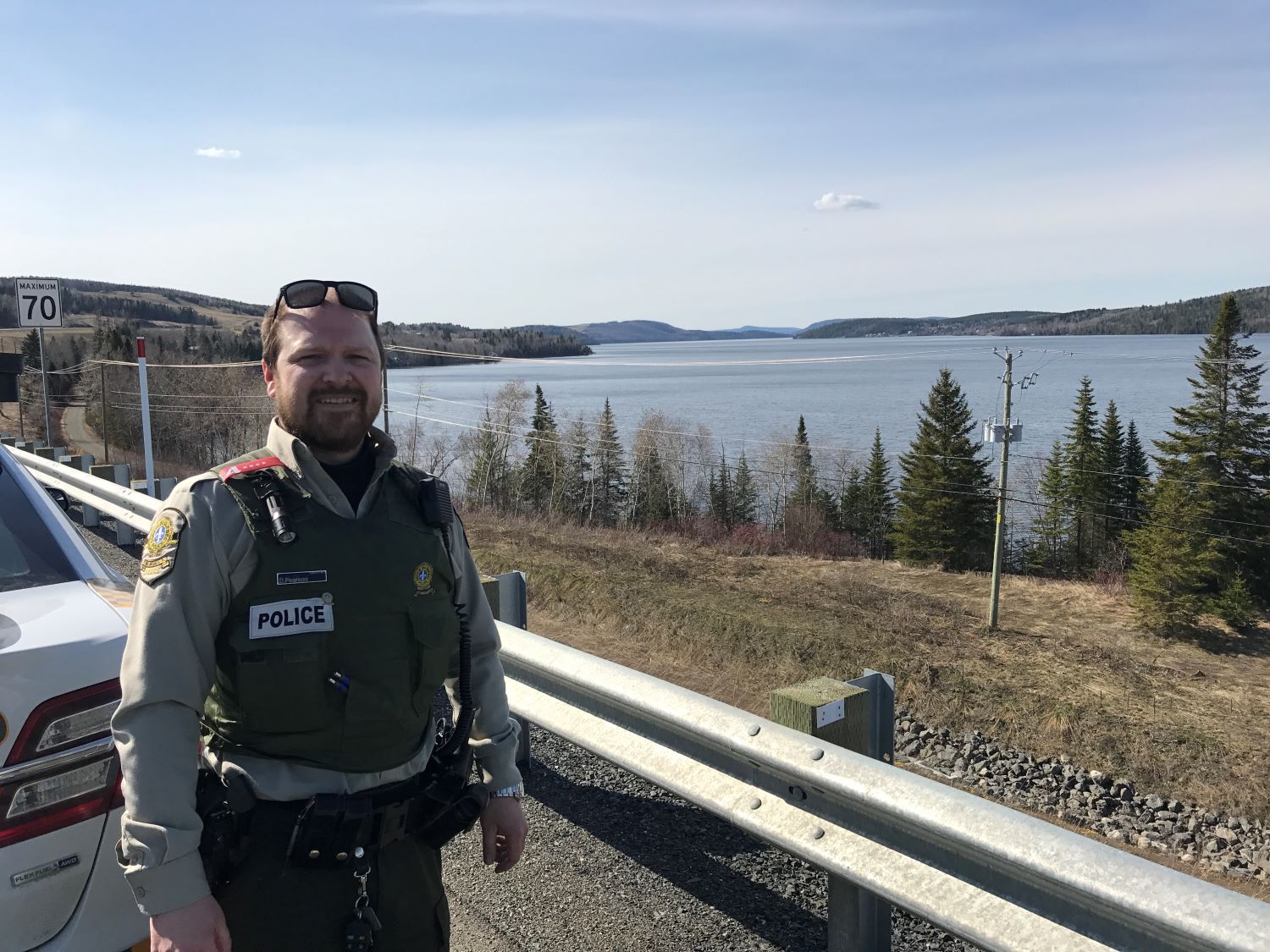
I am stopped on the highway by the Quebec police, which is okay, since I had wanted to confirm that my planned route through the province would be okay with them, since many of the highways in Quebec do not allow pedestrians. As luck would have it, I am stopped by probably the nicest police officer in the force. Yes, I am illegally walking on the highway. He asks for my story and my credentials (I give him my driver’s license and veterans card). His English is poor, but much better than my French, so he tries his best in English.
“How long from Halifax to here?”
“Fourteen days.”
“Whoa!”
Apparently, the stretch of highway from the Quebec border near Edmunston to Rivière-du-Loup at the St. Lawrence River is not what it seems on the map. It looks like a single highway, but it’s a series of major and secondary highways all linked together. It’s illegal to walk on highway 85, a major highway.
“It’s the only way to get to the St. Lawrence,” I say.
He nods. “I see your dilemma.”
The officer gets on his cell and talks to his boss. I can discern that he is trying to get permission for me to walk to St. Louise-du-Ha! Ha!, where highway 85 turns into 165, a secondary highway. The answer is obviously ‘no’ because he curses and hangs up.
“Do you want me to drive you to Rivière-du-Loup?”
“No, merci.”
“Can I drive you to Cabano (where I tell him I would take a hotel. I mean, I couldn’t tell him I was stealth camping)?
“No, merci.”
Then he goes onto Google maps. “Up ahead two kilometers is exit 24. You can take secondary roads to Cabano.” And then he proceeds to show me on his phone. “But after Cabano, you can’t walk on the highway for 12 kilometers to St. Louise-du-Ha! Ha! Unfortunately, there is no bypass road. You will need to get a ride or take a taxi. I’m sorry, my friend.” And he genuinely looks sorry.
The officer says he would like to drive me to exit 24, even though it is only two kms away. He can’t allow me walk it. “Really?” I ask. “You would drive me there?”
“Oh yes. All part of the service,” he beams.
I ask how we would get my jogging stroller into the police car. “We will find a solution!” he says enthusiastically.
And we do fit her in, although we have to remove her front wheel to do it. While the officer is helping me unpack the stroller, he suddenly stands up and says with feeling, “You, my friend, you have courage!” I look up at him and he taps his fist against my chest. “Courage!” I thank him for his kind words.
In the car, we talk about his family. He’s married to a police officer he met in Basic Training. They have two children, five and six. We talk about the challenges of being posted apart, about the challenges of his working the night shift for seven days, followed by his wife working the night shift for the next seven days. He asks me about my military postings.
We must drive quite a way up the highway before we can turn around. When we arrive back at exit 24, he points at the lake. “Lac Temiscouata. It is 42 kilometers long. It is my favourite lake in the world. I have a little boat I take out on it in the summer. This is my place. I want it always to be my home.”
We leave one another rather sadly, I think. It seems we both just want to go for a beer and talk about life. He is a very likable fellow.
I am happy to have met this officer. He had nothing in mind but to help me solve my problem of getting from point A to point B. He was courteous, friendly, helpful, and a real joy to be around.
After he drops me off, I walk through a village called Notre Dame du Lac. A car pulls up beside me and man asks me about my trip. “I saw you this morning way back in Edmunston,” he said. His name is Albert (which he pronounces Al-bear). He asks if I need anything. “You are doing a very good job,” he says. I thank him and he drives off.
And now I’m in a motel in Cabano instead of stealth camping because I told my officer friend I would be.
The next morning, I realize that I don’t have to take a taxi to St. Louise-du-Ha! Ha! after all. My friend, Derrick, alerted me to an alternate route south along highway 232 to Maine and then west to the St. Lawrence. On a road map, it looks like highway 232 dead ends at Maine near a town called Rivière-Bleue, but it actually skirts the border to a town called Pohenegamook. (Yep, that’s the name). From there, it’s about 65 km through the forest to the St. Lawrence River. The route will add another 15 km or more to my original route and I’ll have to backtrack a kilometer or so to access the highway, but it’s certainly viable.