[Portugal]
Dates: November 22 – 26, 2024
Route: Lisbon to Fátima, Portugal
Distance: 150 km
Walking Days: 5
Average Distance/Day: 30 km/day
Fátima, Portugal, is a pilgrimage, it seems, that is more sacred to the Portuguese people than Santiago de Compostela.
It is purported that in 1917, the Virgin Mary, known as Our Lady of Fátima, appeared before three children while they were guarding their families’ sheep.
The children claimed only that they were visited by a lady in white, but then others witnessed her return visits with the children.
I’m greeted on my first morning of the Camino Portugués by Maria, a lovely woman who works at the hostel and who smiles easily.
The coffee is already brewing and she makes me eggs long before the official breakfast hour.
Soft guitar music plays on the sound system.
I speak a few Portuguese words to our hostess and she says Portuguese people like it when foreigners try to speak their language.
Suddenly there is a problem with the cash register, a piercing alarm that Maria has never heard before and which has baffled both of us as we try to fix it.
Finally, she texts her boss for guidance while I finish making the breakfast.
Maria gets me a coffee and offers me a homemade heart-shaped cookie from a Christmas tin.
She has made these cookies herself, and they are delicious.
Finally, Maria manages to fix the cash register and the room is again filled with guitar music.
Soon, we are joined by a young Italian traveler.
We chat and she shows me her Camino tattoo, although on this trip, she does not intend to follow the Way.
I get off to a late start on my Fátima pilgrimage adventure, since the Lisbon Cathedral doesn’t open until 1000.
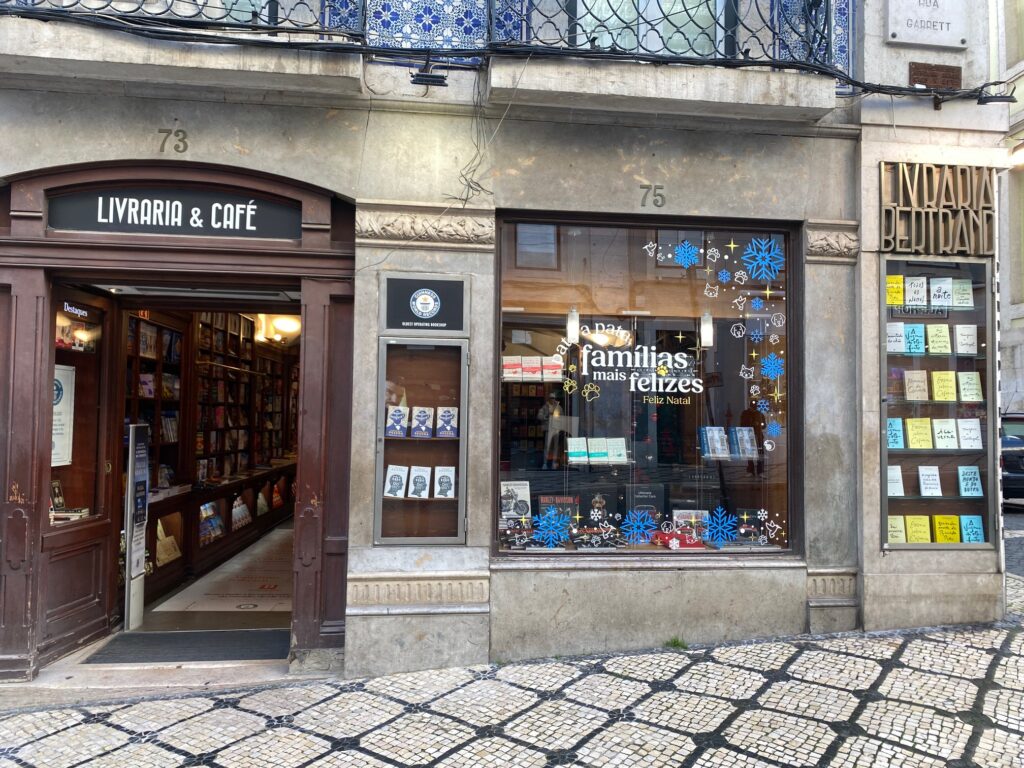
At 0900, I am at the Livraria Bertrand, the oldest in the world, established in 1732.
I buy a poetry book of famous Lisbon poets, which has the original poems in Portuguese on the left pages and their English translations on the opposite pages.
I get the book stamped by the bookstore clerk – “We hereby certify this book was bought at the oldest operating bookshop in the world.”
I also buy a postcard for a friend and ask the clerk to stamp it too, but she won’t because it’s not a book.
There is no stamp certifying that “this postcard” was bought at the oldest operating bookshop in the world.
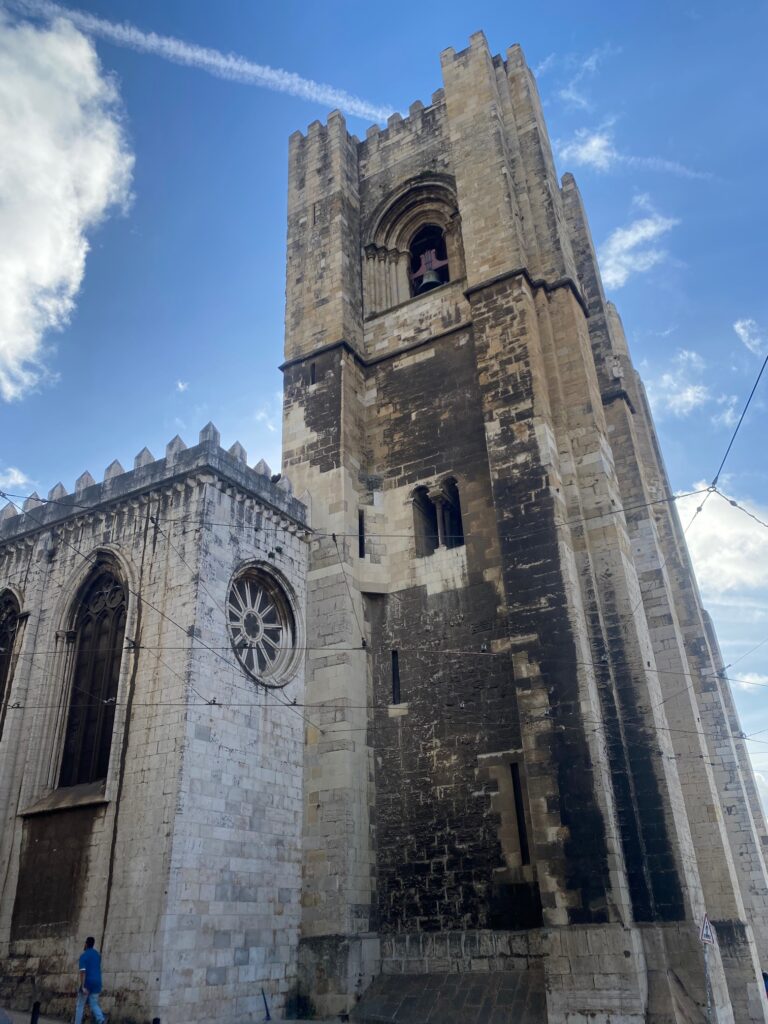
At the cathedral – Sé Catedral – I buy a scallop shell, a common identifier of the Camino de Compostela, which I will continue following after reaching Fátima, and I hang it on my pack.
I also get my pilgrim passport stamped, officially starting the Camino Portugués.
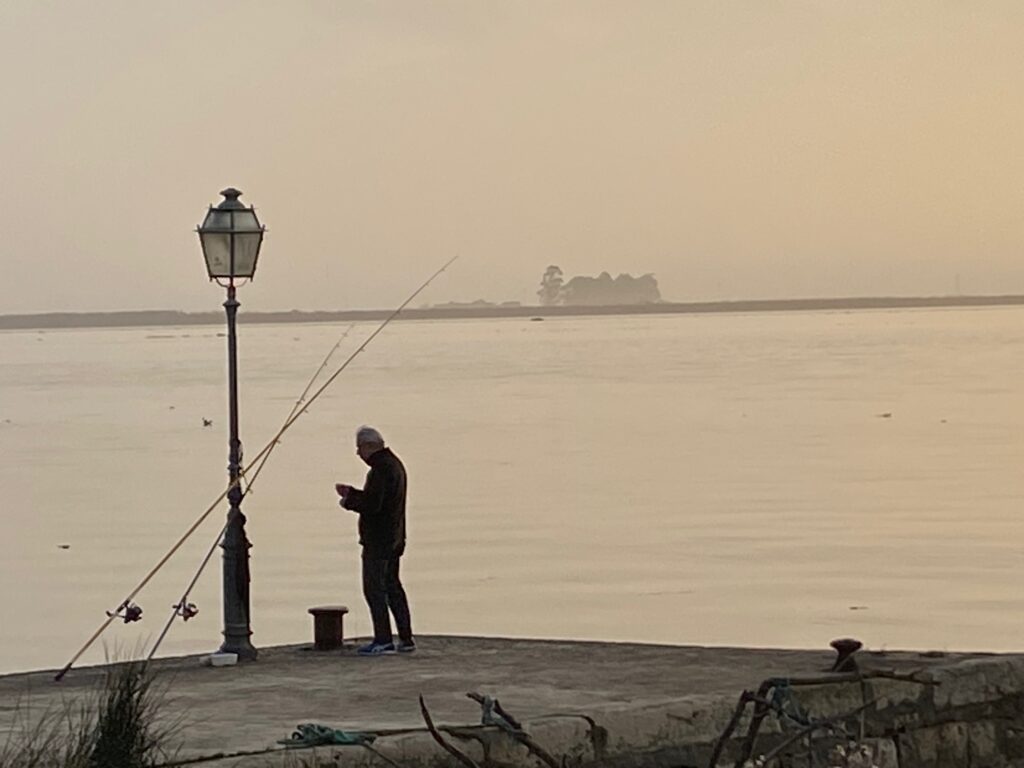
The route from the cathedral winds through beautiful cobblestone streets and eventually exits at a new boardwalk that parallels the Tagus River – Rio Tejo.
I end my day eating grocery-store sandwiches at a pension in Alverca do Ribatejo, where the lighting in the room is so poor that I need my headlamp to read.
No blisters, but the feet are sore.
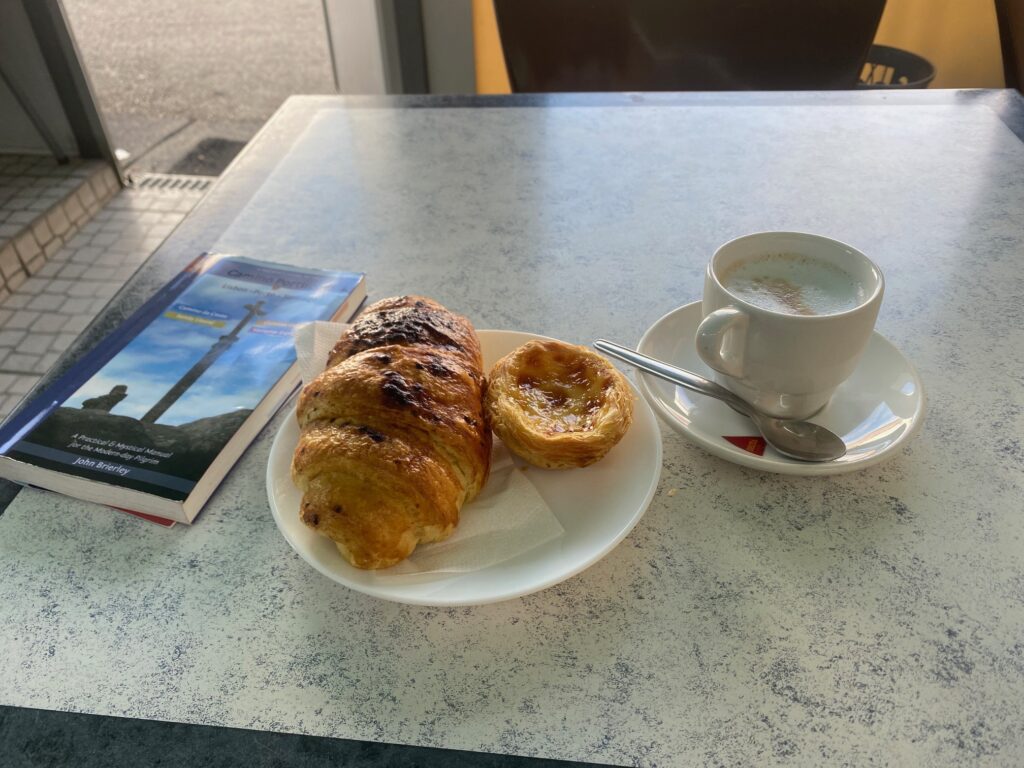
In Vila Nova da Rainha, Portugal, I find a café and order three pastries, a Coke Zero, and a large coffee.
The two gentlemen working there are very gracious and we communicate well enough though they speak no English.
On the patio, a local man befriends me and we chat briefly, mostly with sign language, since he also speaks no English and I exhaust my Portuguese vocabulary in about thirty seconds.
He leads me to understand that mixing a Coke Zero and a coffee will make my stomach upset and make me sick.
It doesn’t, and I refrain from mentioning to him that his chain smoking is probably even less healthy.
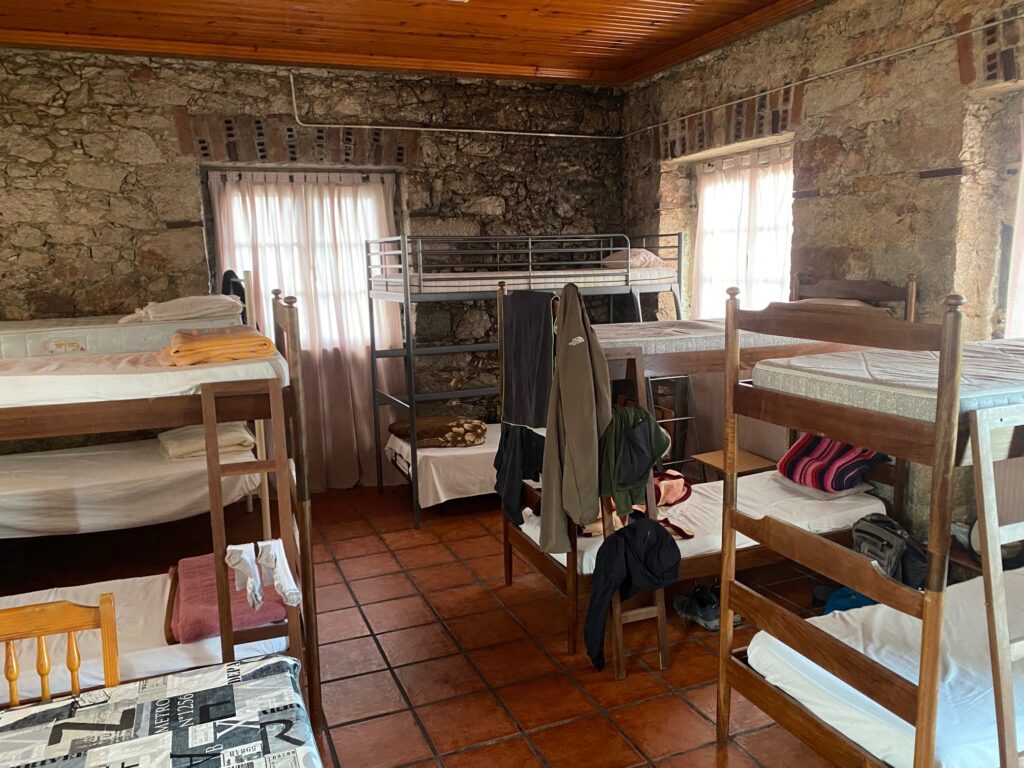
At the albergue (pilgrim hostel), a young volunteer named Maria greets me and I’m delighted that her English is excellent.
Carlo, an older man, also a volunteer, joins us and I find him to be quite knowledgeable about Canada – he has friends in Ontario and Nova Scotia – and a very interesting conversationalist.
He is also a coin collector, so he is excited when I give him all of my spare change from my Eastern European trip, which he counts meticulously and then converts the money into Euros.
He insists on paying me for the coins, but I won’t take his money.
We decide on a payment of half the amount which, after we agree, he puts into the donation box.
We talk about the Cold War, back when we were both in Germany working in our respective armies.
He was also there when the wall came down in Berlin.
We are joined by a German cyclist, Michael, and the talk turns to etymology, the origin of words.
Michael studied linguistics for his undergrad.
He tells us about the origin of the word ‘discover’.
He says the word ‘discover’ is the same as ‘dis-cover’, that is, to take the top off of something to look inside.
Fascinating stuff.
Maria is fascinating and wise, currently studying biomedical engineering at university.
She’s not so sure it’s a good fit for her social personality, working in a lab all day.
She thinks it’s sad to have to decide what you want for your career at such an early age.
But she’s not worried; she will live as she wants and do things she likes.
I tell her I still don’t know what I want to do when I grow up.
She says that’s okay, that I have already done some things and I will do more things in the future.
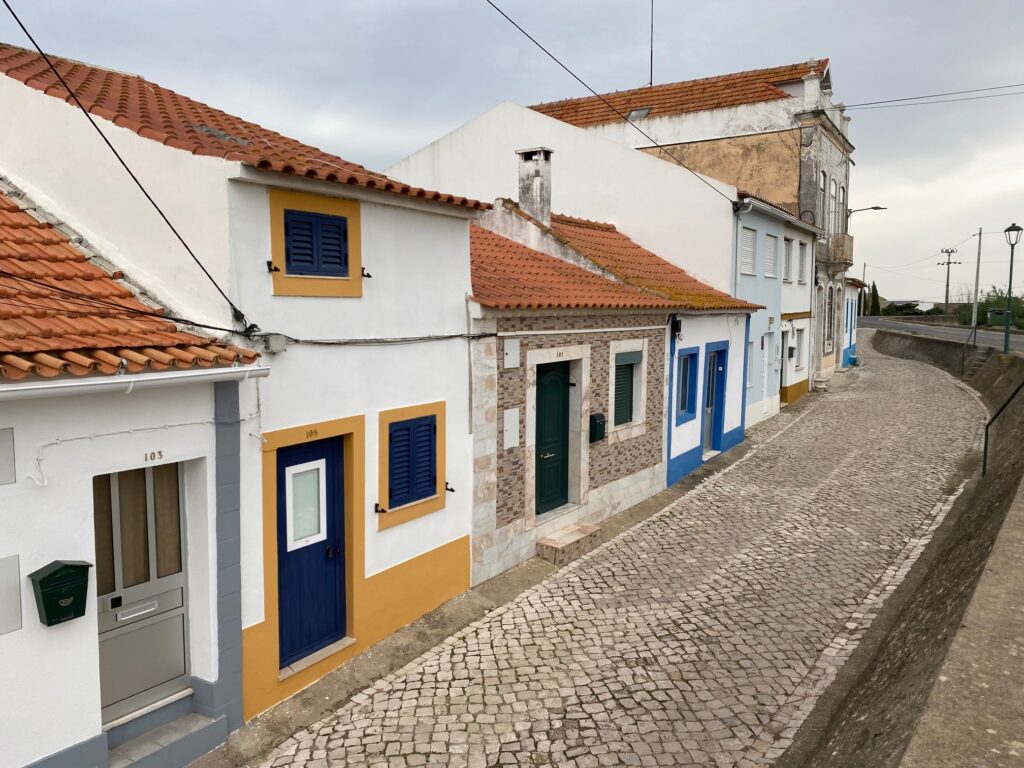
I walk along the Rio Tejo through villages, but am intrigued most by Regueno, where there is a row of houses behind the levee.
Each house has a picture of a saint or a priest or a church.
The levee protects the village from flooding when the Rio Tejo gets anxious.
The levee is quite high, about the height of a one-story home, and is very close to the houses, with just enough distance to allow a narrow road to pass through the village.
One would have to climb to a second-story window to enjoy a view of the Rio Tejo or anything beyond the levee.
So far, we know the levee was built to exactly the correct height, because in 1979, the water rose to within a few centimetres of the top.
Beyond the village, in Santarem, I cannot find a simple café without having to walk all through the city.
I decide instead to take my coffee at a shopping mall, where I continue to enjoy those tasty Portuguese custard tarts – pastéis de nata; indeed, I have had them every day on the Camino and will continue to do so until I reach Spain.
I have not seen another pilgrim up to this point, so I am delighted to meet a South Korean gentleman named Park Yon-Jin.
He has been struggling with painful blisters.
I actually passed him yesterday while he was sitting barefoot and cross-legged off the trail, but I didn’t see a pack, so I didn’t think he was a pilgrim.
He tells me that when he saw me walking by with a strong pace, he was motivated to get back up and keep walking.
My new South Korean pilgrim friend prefers to walk alone.
He leaves our albergue before I even get out of bed, but I catch up to him before noon.
He is struggling and in considerable pain from his blisters, which are deep and cover all parts of his feet.
But now, he is suffering even more because he has severe chafing between his legs and is walking very slowly and with his legs as far apart as he can manage.
I can do nothing for his blisters, but I give him some cream for his legs and suggest he pick up some boxer shorts in the next town.
I tell him I used to also get chafing on my legs when wearing briefs and haven’t had a problem since I started wearing a brief-boxer hybrid.
When I arrive in Monsanto, I cannot find the only albergue in town, and it’s then that I realize I am in a very small rural town because there is no one who speaks any English.
Still, with sign language and some pointing at a map, I find the hostel and then finally the man in town who will give me a key.
I’m delighted to find my South Korean friend at the albergue and soon discover that his troubles with his blisters and chafing was only part of his problem today.
Sadly, he has also lost 180 Euros, a tidy sum, which must have fallen out of his pocket when he stopped to rest.
When he realized his money was missing, he started to walk back looking for it, but soon gave up because he was in too much pain.
He’s had a challenging Camino so far, but he’s still smiling.
He is well into his thirties but says that he hopes to get married one day, that marriage and a family is the one big thing missing from his life.
I don’t speak any Korean at all and Park’s English is very poor, so he translates everything on his phone.
We talk late into the evening and get a little tipsy on Portuguese beer.
A grand evening.
Park Yong-Jin and I leave our albergue early in the morning while it is still dark.
I use the light on my phone at every crossroads to look for the fleche – arrow – to ensure I’m on the correct path.
Park prefers to walk alone, so he follows me for about three kilometers before he drops off.
I miss his companionship, so I linger at a café along the route for nearly an hour waiting for him, but he doesn’t pass by.
He has been in pain, and this day has had its fair share of hills and rocky trails, so he’s probably stopped more frequently than usual.
He said he intended to make it all the way to Fátima before the end of the day, about 26 km, and that he would stay there the night.
Sadly, I never see him again.
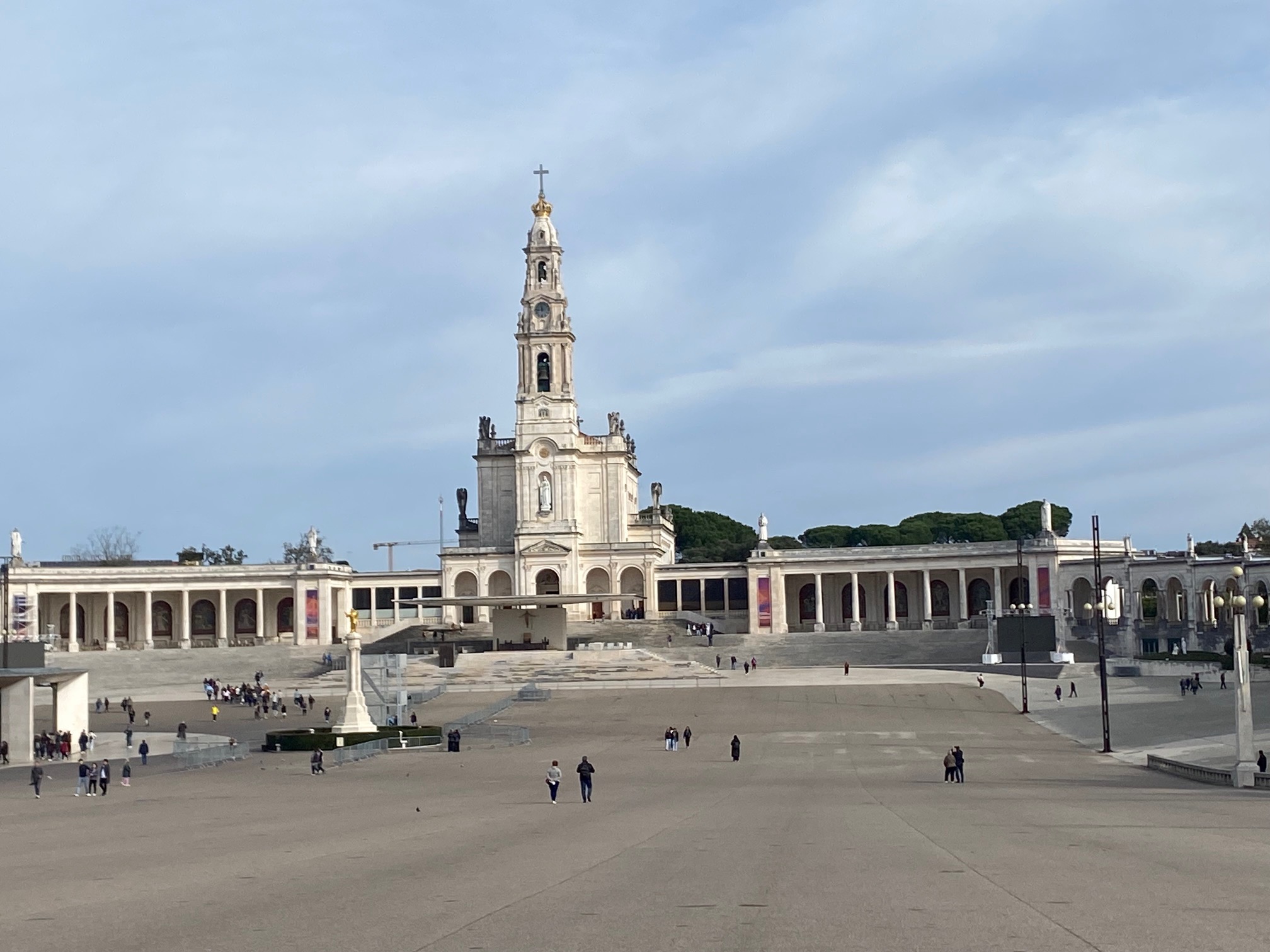
I was excited to finally arrive at the Cathedral in Fátima, but I didn’t stay long.
Although I arrived in late November, the Cathedral was still packed with tourists.
The parking lot was mostly full with cars and buses.
When I went to get my pilgrim stamp at the information office, I was jostled by tourists.
Even simple courtesies, like waiting one’s turn, are not necessarily observed, even at a religious centre.
It was nice to get out onto the cathedral grounds, into the open air, where I could find a quiet place alone.